
Is the buyer asking for more packs—or a different product?
A customer who wants three openings of one release may welcome a three-pack price. A customer collecting unopened boxes may not want loose packs at any discount. Decide which offer you are preparing before printing a sale label.
A public Pokémon seller offered five loose Evolving Skies packs individually and at a lower total for all five; a buyer accepted and later reported receiving the packs. That shows one quantity offer found a buyer. It does not tell us the seller’s costs, profit, or whether the same offer would work for Simplified Chinese stock. A separate discussion about the price of six loose packs versus a manufacturer’s sealed booster bundle shows that outer packaging itself can matter to buyers.
For your shop, ask a concrete question: “Do you want three unopened packs of this release, or do you want an intact factory-sealed product?” Keep the whole-product option separate. Do not open the last reserved box to create a promotion for a different customer.
Start with one release, one language and one pack format. A mixed assortment is a different offer: list every included release, format and count, then cost those specific packs. Adding unwanted releases does not create value for a buyer merely because the total pack count rises.
Make the three-pack unit unmistakable
For a concrete example, consider Collect 151 Journey 旅, Simplified Chinese, 5-card packs. Pokémon China’s product materials identify that 5-card pack format. A shop can choose to offer three individually unopened packs together; the number three describes the shop’s offer, not a manufacturer’s package.
Use a title such as “3 × Collect 151 Journey 旅 5-card booster packs — Simplified Chinese — shipped unopened.” Put “three packs per order” beside the quantity selector. Quantity two would buy six packs. Photograph the offered quantity and label reference artwork as reference artwork.
A reusable description is:
One order contains three individually unopened Collect 151 Journey 旅 booster packs in Simplified Chinese, five cards per pack. This is a group assembled by our shop, not a factory-sealed three-pack product. Source and selection: [replace with your verified lot history and the method used to choose these three packs]. The booster box is not included. The price applies to the three packs together.
Replace the bracketed instruction before using the description. If the lot cannot be traced to a particular box, say that; do not imply a fresh-box origin. Our loose-pack selling guide explains the source and selection records. A quantity offer changes the price and number of packs, not what you can substantiate about their contents. Do not add a target-card or hit guarantee.
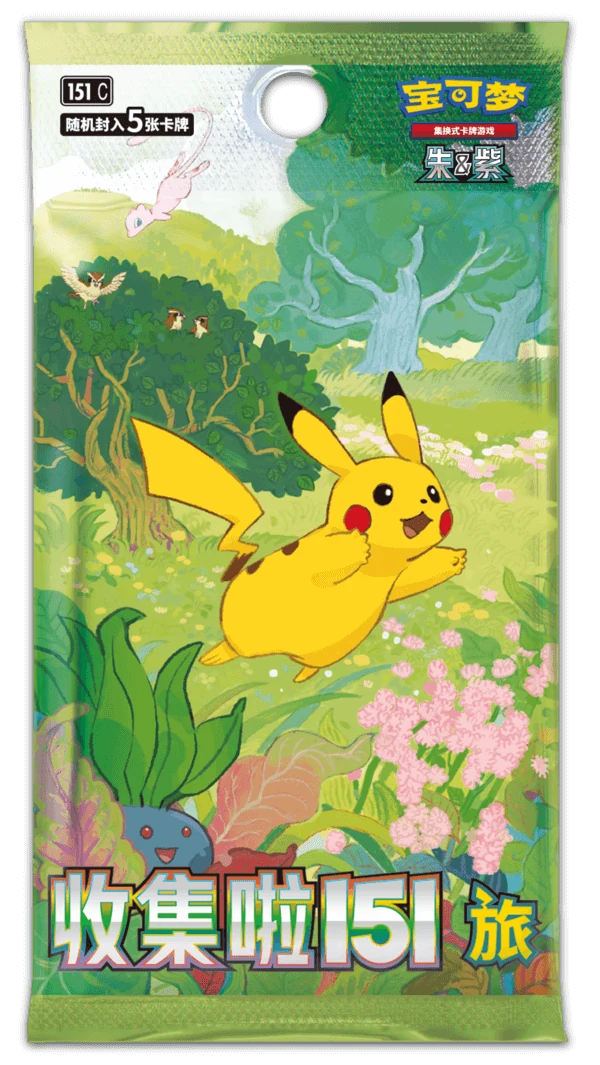 3 × Journey 旅 5-card packs
Simplified Chinese · individually unopened · shipped sealed. State the actual source and selection method.
- Quantity 1 = three packs
A group assembled by the shop; no factory-sealed three-pack product or booster box is implied.
Use your own offered-quantity photo in a sales listing. This single-pack reference identifies the format.
Existing unaltered product reference; the offer is an illustration, not current stock or a site sales promotion.Which costs actually fall when three packs become one order?
The cost of the three packs does not disappear. What may change is the number of checkouts, parcels and handling steps. In a public sealed-Pokémon sales thread, a seller explicitly linked larger-order discounts to saved shipping costs. When a different buyer requested a further reduction, the seller held their price. The useful lesson is to calculate what this order saves; that seller’s old prices are not a pricing benchmark.
Compare the transaction the buyer will actually make. Three packs already bought in one checkout and sent in one parcel do not create the same savings as three separate one-pack orders. If your regular customer would have paid the full three-pack total in one order, the discount reduces what that order contributes unless it changes something else you can measure.
Before setting the offer, write down the landed cost of the included packs, applicable selling and payment fees, packing materials, handling allowance and any shipping you fund. Weigh the actual protected parcel. A larger packet can cross a shipping bracket; three packs do not automatically cost the same to send as one.
Whatnot’s current fee guide distinguishes commission from payment processing, and the processing calculation includes buyer-paid shipping and taxes. Rates depend on the applicable market and account circumstances. Use the rate and fee bases that apply to your sale. Combining parcels is not evidence that every transaction charge has disappeared; inspect the order’s actual fee breakdown instead of treating shipping bundling as a fee refund.
A worked example: $1.50 off can beat $3 off
Hypothetical teaching example, in USD. These are invented shop inputs, not Legendary Sealed prices or Whatnot rates. Suppose one named pack sells for $4 and costs the shop $2 landed. This example charges 10% of item revenue plus $0.30 for each checkout. Packing and a handling allowance cost $0.60 for a single-pack order or $0.85 for one three-pack order. Assume shipping is recovered separately with no shortfall; this simplified fee model does not charge fees on shipping or tax. Replace that assumption and all figures with your actual costs.
Here, “contribution” means item revenue minus these stated pack and order costs. It is money toward overhead and profit, not net profit.
Scroll the table sideways to compare all columns.
| How the same three packs sell | Item revenue | Pack cost | Fees | Packing and handling | Contribution |
|---|---|---|---|---|---|
| Three separate $4 orders | $12.00 | $6.00 | $2.10 | $1.80 | $2.10 |
| One three-pack order at $12 | $12.00 | $6.00 | $1.50 | $0.85 | $3.65 |
| One three-pack order at $10.50 | $10.50 | $6.00 | $1.35 | $0.85 | $2.30 |
| One three-pack order at $9 | $9.00 | $6.00 | $1.20 | $0.85 | $0.95 |
At $10.50, the group leaves $0.20 more than three separate orders in this model. At $9, it leaves $1.15 less. Yet $10.50 also leaves $1.35 less than a customer paying $12 in one checkout. That is the comparison to use when your customers already buy multiple packs together.
If your chosen minimum for this group is the $2.10 contribution from three separate orders, solve 0.90 × group price − $6 − $0.85 − $0.30 ≥ $2.10. The minimum rounded upward to cents is $10.28 under these assumptions. That is a calculation boundary, not a recommended selling price. You can require more contribution, keep the full price, or decline the offer. A missing fee or shipping subsidy raises the boundary.
- $2.10Three separate $4 orders
Contribution after the example’s pack costs, fees, packing and handling.
- $2.30One $10.50 group order
$0.20 above three separate orders; $1.35 below one full-price $12 group order.
- $0.95One $9 group order
$1.15 below three separate orders under the same assumptions.
Choose the comparison your buyer would actually make. No automatic sales or profit increase is implied.
Teaching figures from the table; not site prices, actual sales or platform rates. Contribution is before business overhead and profit.Test the offer without confusing pack volume with improvement
Reserve a limited number of uncommitted packs from the exact release and format for the test, and choose a review date before offering them. Keep a normal single-pack option if that is a customer need you already serve. Do not buy another box merely to keep the discount available.
Record the quantity sold, actual item revenue, actual fees, packing and seller-funded shipping, plus the packs left. Keep single-pack and multi-pack orders separate. Note whether buyers wanted the quantity, asked for a different release, or mistook the offer for a factory-sealed product. If a buyer would not have bought at full price, that is useful feedback, but it is not proof of all the additional sales the promotion caused.
Keep the offer when its fulfilled orders meet your chosen contribution requirement and the named group solves a buyer’s request. Raise or remove the discount when postage or fees erase the expected saving. If existing customers simply switch their usual three-pack purchase to the cheaper listing, compare the reduced contribution with any additional fulfilled sales before extending it. If customers keep asking for one pack or a sealed box, keep selling those units rather than forcing the three-pack format.
A deliberate clearance can accept less contribution to recover cash from slow stock. Record it as clearance with a defined quantity and cash outcome, not proof that the discounted price supports routine restocking. Use the restock guide when deciding what to buy again.