
Who is buying the next pack?
Imagine two customers at your counter. One wants an inexpensive way to try a particular release. The other wants to take the unopened box home. You can serve either customer with the last sealed box on the shelf, but removing the first pack ends the second option. If that box is already reserved, keep it out of the pack inventory.
One shopper asked about buying individual Simplified Chinese slim or jumbo packs because the initial outlay was smaller than buying a box. Their question about buying individual packs rested on their own unverified assumption about guaranteed pulls in boxes. Give the shopper the price for one pack of each requested format so they can choose an opening they can afford. Treat the question about pack contents separately. Buyer’s question about Chinese single packs
Some buyers care who opened the box. In a local card shop discussion, one person wanted to buy a few packs after work, while another preferred packs from a freshly opened display. In a separate discussion, a participant said they might buy a pack from a box in a shop but would pass on an online offer. Ask which matters to your customer. Someone who wants to watch the box being opened needs an arrangement at the counter. Someone who wants a 25-card opening may be satisfied with a clearly described loose pack online. These are individual preferences. Local shop buyer discussion · In-store versus online pack purchases
A real pack format that changes what you can say
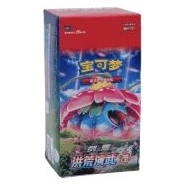
Consider 洪荒演武 茂, listed in our series directory as Primordial Arts – Overgrow, CS3aC. In its 2023 announcement, Pokémon China specified six 25-card packs per retail box for this release. It also explained that the 5-card version would be sold individually instead of in retail booster boxes. The product specification gives one foil in the 5-card pack and five foils in the 25-card pack, with cards randomly inserted. Pokémon China release announcement and specifications · Overgrow packaging reference
A shop that opens a matching six-pack box can document the 25-card packs it removed. For the separately sold 5-card format, describe the individual retail pack you actually received. A supplier sending several of those packs together does not establish that they came from a factory booster box. Apply these figures only to the documented release and format. Match the physical pack before writing the listing.
The published foil count answers a real buyer question. You can explain that the 25-card pack is specified to contain five foils. That count tells the customer nothing about which particular illustration or rarity they will pull.
Turn one box into pack stock once
Give the box and the pack separate shop stock codes, or SKUs. The SKU identifies the product and selling unit. A separate lot note identifies which physical box supplied the packs. Two packs of the same release and format can share a SKU while having different source histories.
Illustrative stock record. Suppose your shop opens one confirmed six-pack Overgrow 25-card box. The example codes and quantities below describe a teaching scenario.
Scroll the table sideways to compare all columns.
| Stock event | What the shop records |
|---|---|
| Before opening | One sealed box under OVERGROW-25-BOX. No packs from this box are listed separately. |
| At the counter | Remove that one box from sale as a sealed unit. Count six individually unopened packs and enter them under OVERGROW-25-PACK, lot L7. |
| Later that day | Two packs sold, one held for an online customer and one opened by staff as a sample. Two packs remain available for a new order. |
Of the six packs, two were sold, one was held and one was opened, leaving two available. There are still three unopened packs physically on hand, including the reserved one. If your counter and website share that stock, show the same two available across both channels. Offering two on each channel as separate stock would promise four packs.
Keep the opening date, release and format, count found, selection method and subsequent movements with lot L7. If a count differs from the expected six, resolve the difference before listing the packs. If you mix boxes or receive loose stock from a supplier, keep the origin records separate or narrow the wording to what you can still trace.
- 6Packs received
Remove the opened box from intact-box inventory.
- −2Sold
Two packs have left stock.
- −1 −1Reserved + opened sample
Neither is available for a new sealed-pack order.
- =2Free sealed packs
Three sealed packs remain physically: one reserved, two free.
Two listings for packs that look alike
These are sample descriptions for a retailer to adapt to its own verified stock. The first describes lot L7 after the sample pack has been opened.
Primordial Arts – Overgrow (洪荒演武 茂), Simplified Chinese, one unopened 25-card booster pack. We opened the six-pack retail box in our shop. One pack from that box was opened as a staff sample. For online orders we take the next available unopened pack from this lot. The retail box is not included.
Use different wording if the supplier delivered individual packs and your shop never saw the source box.
Primordial Arts – Overgrow (洪荒演武 茂), Simplified Chinese, one unopened 25-card booster pack. We received these as individual packs. We cannot identify the original box for this lot. Quantity one buys one pack.
Show the pack a customer will receive, or label a representative pack photo clearly. A photograph of a sealed retail box alone invites a mistaken order. If the online price is per pack, put the unit beside the price and repeat it at quantity selection. An order for six loose packs is still an order for loose packs, even when all six originally came from one box.
 Your shop opened the source box
Identify the six-pack box and lot; disclose the staff sample if one was opened. The buyer receives a pack, not this box.
- You received individual packs
Say so. Do not claim to have opened a factory box that your shop never saw.
The same pack format can need a different description of its source.
Existing source-box reference, shown at its original small resolution. Use an actual-pack photograph for the listing; the retail box is not included in the example pack offer.What if the buyer asks whether a hit is still in the box?
Answer the part you can observe. For lot L7, the shop can report that it opened one sample and sold two unopened packs. It cannot report what the customers later pulled unless they told the shop, and a reported pull would still be an individual result. If the shop opened packs until it found a card it wanted, disclose that selection history. A buyer may choose a different lot once they know it.
An online listing that says “random pack” can leave two questions tangled together. Pokémon China describes the cards inside the pack as randomly inserted. Your shop separately chooses which physical pack to send. Say whether the customer chooses from the display, the shop takes the next pack in order, or it actually draws at random. Use the method you describe.
One participant identifying themselves as a shop operator said that their own shop did not weigh or scan packs. A retailer with a documented handling practice can describe its own actions over the period it controlled the stock. A statement about the shop’s handling cannot establish what happened before receipt. If the wrapper is open or its condition puts the sealed description in doubt, set that pack aside for inspection before offering it as unopened. Shop operator’s account
For the next buying decision, count completed pack sales separately from sealed-box sales, reservations and staff openings. If customers keep asking to take the whole box, hold one intact before breaking another. If customers want one affordable opening, use completed pack sales and the quantity still available to decide when another box is worth splitting. The first wholesale order guide covers how to specify that upstream purchase.